Just watch this fantastic video about the life of a plastic bag. I know it doesn't sound good but it really is one of the best short films I've seen.
It would be a fanastic resource to use to explore issues of sustainability and waste in many areas. I think it provides a great way in to English, very obviously media studies as the filming, imagery and story are very striking. It could also fit into religious education or philosophy as well as Society and Environment.
Here's the synopsis:
This short film by American director Ramin Bahrani (Goodbye Solo) traces the epic, existential journey of a plastic bag (voiced by Werner Herzog) searching for its lost maker, the woman who took it home from the store and eventually discarded it. Along the way, it encounters strange creatures, experiences love in the sky, grieves the loss of its beloved maker, and tries to grasp its purpose in the world.
In the end, the wayward plastic bag wafts its way to the ocean, into the tides, and out into the Pacific Ocean trash vortex — a promised nirvana where it will settle among its own kind and gradually let the memories of its maker slip away.
This video could be combined with a clean up. I've just found out about the organisation Tangaroa Blue at www.oceancare.org.au. They are focussed on cleaning up coasts, getting rid of all the plastic waste that endangers wildlife and generally makes the coast look rubbish. They help organise clean ups across australia. Students can take part, record what they collect and send their data Tangaroa to be included in their research projects. Tongara Blue have also produced some teaching resoruces to go with this for schools in WA. Contact them for the CD. Its called Ocean Full of Plastic: marine debris education resource for WA schools. There's a beach clean up for the SW organised for the 8th & 9th October if you want to get involved.
I've also found a podcast from Costing the Earth about this too. Dr. Alice Roberts investigates the discovery of the World's largest plastic waste patch in the South Atlantic and asks what we can do to solve the problem of aqatic plastic.
http://www.bbc.co.uk/programmes/b00v1qtn
Lots of links to other great resources about this issue on this page too.
Showing posts with label Consumption. Show all posts
Showing posts with label Consumption. Show all posts
Wednesday, September 22, 2010

Tuesday, September 21, 2010
Fun and Inspiration at the Weekend
 |
| David and Skye in Action. Skye liked the dancing book. |

 |
| Ingrid spreads the word. Giving away packets of coriander seeds hleped too. |
We had a fantastic weekend at the Hulbert Street Sustainability Fiesta. Ingrid and I shared duties on our stand over the weekend, David and Skye helped me out ;) and Tundi (?), Ingrid's daughter had organised a fashion remodelling/recycling area futher up the street and had made herself a great outfit. Maybe Ingrid can post a photo?
I really enjoyed hearing how enthusiastic people were about what we are doing with Schools. You would hope they would be at a Sustainability fiesta but nonetheless people were eager to talk to us and very encouraging. Our coriander seeds ran out and the leaflet stock was depleted. We got quite a few names on our living library list too. This is a new idea which I hope we will develop over the next few months so thank you to those that signed up, I'll be writing more to you soon.
So many people there doing great work. Shani and Tim of course for organising it all, opening their house and accomodation at the Painted Fish and generally getting people in their community on board.
 |
| Its down that way, no up that way! So many things going on it was hard to keep track. |

I had some good conversations with Helen and Tim at Sustainable Energy Now. I'm impressed by their campaigning. Some good stats in their brochure....did you know that if just a quarter of homes currently supplied by synergy got a 1.5kw solar system this creates as much energy as the current coal fired power genration in WA. The friendly people at Fern community gardens opposite also signed up to our living library.
I loved the 'recycled' bikes. I
 've got a groovy rusty blue retro one myslef and was pretty inspired to try turning it into one that I could carry Skye in. Here's a just one of the many creations.
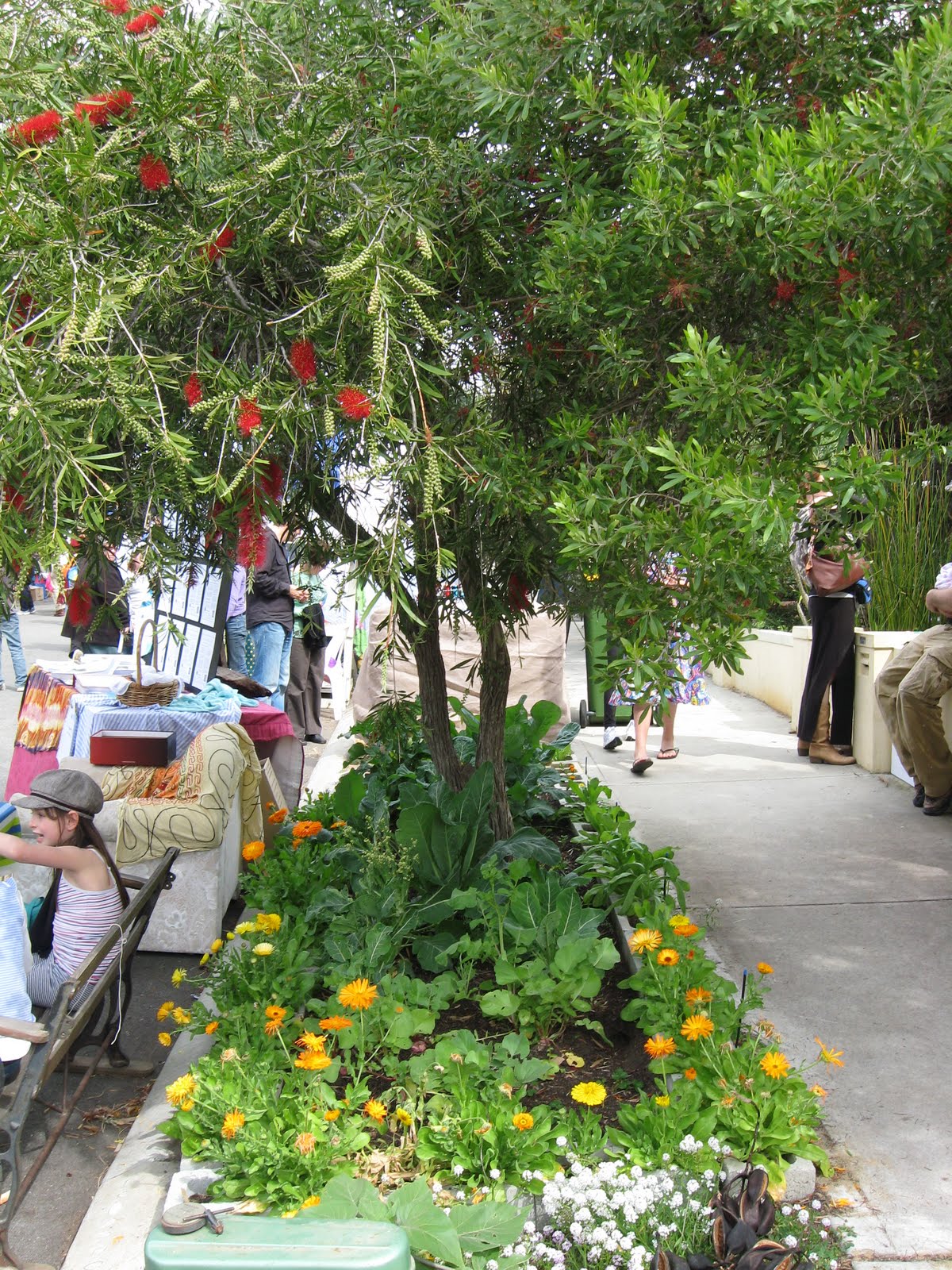
Guerrilla gardening was in evidence. Not sure if the chickens stay out on the verge all the time but the vegetables in the verge looked (and hopefully taste) great. So sculptural.


I and many other people I noticed brought a rug from carpetsforcommunities.org. Great little rugs made from recyled t shirt off cuts by women in Cambodia and all profits go directly to them. The stand was run by volunteers. I even got a photo of my rug being made. Its now cheering up our bathroom. If you're going to buy things then I can't think of a better type of enterprise to buy them from.
Loads of stuff for kids, the HotRockers to be; fairy gardens, exercise bikes to generate electricity with, music, costumes. I was really impressed by the model sustainable houses built by Year 6s. We've got a similar model building exercise as the finale to our Global Warming:Global Warning module (see the lesson 'What's the plan?). Its for slightly older students and I have to say I think its a great learning activity at any age. Really creative, allows them to express their ideas and its hands on and practical, makes a change from writing it all up in an essay.


Students from some of our schools were picking out their friends in our photos and other people were happy to find out what their old school was doing for sustainability.
I could go on and on. Can't wait till next year. I'll leave you with my favourite costume.


Wednesday, September 8, 2010
How can happiness help the environment?
I've always been interested in the Psycology of Happiness, what it is that makes us happy and gives us a sense of wellbeing. Living in present, noticing the little things, nurturing our relationships and being part of a community, seeing the positive and doing a bit of exercise to keep all this going or help get rid of your frustrations if you're not seeing the positive!
I'd thought about how these are the important things rather than the material possessions that you have and have gradually changed my life around a bit to make it easier to do more of these things. My mum has been out staying for the past 3 weeks and I'd been talking to her quite a bit about it too and then I came across this video, again in the great green razor newsletter from the Greenpages.
Nic Marks at TED talking about The Happy Planet.
Did you know that that Costa Rica has the same levels of wellbeing as western Countries but achieves this with 1/4 of the ecological footprint? I didn't.
A great video use it with our lesson Feeling Good in the Big Consumption module. We look at Bhutan and how it measures Gross National Happiness rather that GNP and students come up with policies to help achieve that in their country. Marks also talks about how government could encourage this at the end of his talk too. All in all just a great vid which might just help you feel good too! Vertainly put a smile on my face.
I'd thought about how these are the important things rather than the material possessions that you have and have gradually changed my life around a bit to make it easier to do more of these things. My mum has been out staying for the past 3 weeks and I'd been talking to her quite a bit about it too and then I came across this video, again in the great green razor newsletter from the Greenpages.
Nic Marks at TED talking about The Happy Planet.
Did you know that that Costa Rica has the same levels of wellbeing as western Countries but achieves this with 1/4 of the ecological footprint? I didn't.
- They have a life expectancy of 78.5yrs, higher than the US,
- 99% of their electricity is from renewable sources,
- They plan to be carbon neutral by 2021,
- They abolished the army in 1949 and have invested in social programs of health and education instead,
- and well they have a 'latin vibe' which values family and community and having fun.
A great video use it with our lesson Feeling Good in the Big Consumption module. We look at Bhutan and how it measures Gross National Happiness rather that GNP and students come up with policies to help achieve that in their country. Marks also talks about how government could encourage this at the end of his talk too. All in all just a great vid which might just help you feel good too! Vertainly put a smile on my face.
Monday, August 23, 2010
Climate Cartoon
 I was looking for cartoons to illustrate some lessons I am doing on climate change. This one made me laugh and summed up really what we believe here. Whatever you think about climate change the move to more sustainable living has so many benefits in so many areas. Why wouldn't you want to try?
Tuesday, August 17, 2010
Consumption Conundrum
Anup Shah, Consumption and Consumerism, Global Issues, Updated: September 03, 2008
This article really shows how important consumption (as oppsoed to population) in using up the world's resources and degrading the environment. It contains links to articles on particular products and data about how the top 20% of the world's consumers account for 76.6% of the the World's consumption.
This is a quote extracted from the UN.
Today’s consumption is undermining the environmental resource base. It is exacerbating inequalities. And the dynamics of the consumption-poverty-inequality-environment nexus are accelerating. If the trends continue without change — not redistributing from high-income to low-income consumers, not shifting from polluting to cleaner goods and production technologies, not promoting goods that empower poor producers, not shifting priority from consumption for conspicuous display to meeting basic needs — today’s problems of consumption and human development will worsen.
… The real issue is not consumption itself but its patterns and effects.
… Inequalities in consumption are stark. Globally, the 20% of the world’s people in the highest-income countries account for 86% of total private consumption expenditures — the poorest 20% a minuscule 1.3%. More specifically, the richest fifth:
- Consume 45% of all meat and fish, the poorest fifth 5%
- Consume 58% of total energy, the poorest fifth less than 4%
- Have 74% of all telephone lines, the poorest fifth 1.5%
- Consume 84% of all paper, the poorest fifth 1.1%
- Own 87% of the world’s vehicle fleet, the poorest fifth less than 1%
Runaway growth in consumption in the past 50 years is putting strains on the environment never before seen.
— Human Development Report 1998 Overview, United Nations Development Programme (UNDP) — Emphasis Added. Figures quoted use data from 1995
Friday, August 13, 2010
The Population Puzzle
I watched Dick Smith's population puzzle last night hoping that would address some issues of sustainability. Personally I found it quite a dissapointing program in terms of balance and really examining the complexity of the issues but its definitely one that could help spark debate, and indeed the debate after was better.
It all seemed a bit reductionist and very 'conservative'. Dick seemed to want to maintain things as they are. Well ok but even so things are not really ok as they are.
He argued that slower population growth would stop areas of land on city outskirts being concreted over and high rise developments. He argued that we did not want to become like Bangladesh. Well there is some way to go to get to that population, they certainly don't have a problem with lack of water but I would strongly argue that their poverty is not due to overpopulation but to their history. On top of that the environmental impact/carbon footprint of each individual person in Bangladesh is a tiny fraction of an Australian's.
Dick seems to want Australia to stay as it is so that we can continue to consume as we are. He did not talk about reducing our consumption, using less water and energy, living more densley in cities rather than continuously exanding in 1/4 acre blocks (they're an accident of history), sustainable agriculture and renewable energy. At my level of consumption I need about 2.3 planets, way too much but probably not as much as some. That's what we need to change. He certainly did not talk about changing his lifestyle. Yes population adds to the problem but if all the world consumed like Bangladeshis there would not be a climate change problem (although the poverty would lead to other envirnmental problems).
We consume too much and if we want to preserve the Australian (and world) environment it cannot continue. Population is one part of the problem but to only look at this totally ignores the enormous complexity of the issue. Increased population does not correlate directly with ruining the environment or decreasing quality of life. This assumes that what we have now is the right way, that this is the best quality of life we can have. Its not, it needs radical ethinking.
Living in a high density city, with areas with a sense of community, where you can walk to work, walk to the shops, know your neighbours (as you don't just get straight into your car), have easily acdessible countryside (as its not covered in suburbs), have hostpitals, libraries, leisure centres etc all close by could well be a better quality of life than living in a suburb with not real centre where you have to drive to the city centre for work, drive to the shops etc. And it is certainly better for the environment .
I could go on and on.
As you can see a great film to start a debate. This is the website for the population puzzle . It has lots of stats and links to other sites. The opinions page is also good with different points of view, good for getting a class debate going. I like comments by Amanda Mackenzie of Australian Youth Climate Coalition. And this is the Q and A website where you can download the program and look at the transcript. I'm with Suvendrini Perera, and there are also good points about the regions and immigration in general. Also global connections, our global responsibility vs responsibility to our own citizens.
Lots to think about over the weekend, Lucy
EDIT - Well I thought a bit more about this over the weekend. What it really highlighted was that we need a plan. I personally think its impossible to say what a sustainable population is as it depends upon how sustainably they live - if they reduce consuption and change agricultural practices etc. it will be much higher than if not BUT if Australia's population will increase (as it will) it needs to planned for. Where will they live, how will they live, how will they be supported, what policies would encourage more sustainble living, what import, export, agricultural policies, planning and trasport policies do we need to make this sustainable? If there is no plan and we don't think about the Austrlia that we want then we can't work towards achieving it.
I think our lesson 'Our Future' in The Big CONsumption gets students considering this. They envisage the future that they want here and then plan a series of steps in different aspects of life to achieve that. Maybe they can help the government with this?? Its a very different approach to to just looking at what is and then projecting the numbers out and working out how to cater for that, which is I think the main point Dick Smith was trying to make.
Lucy
Monday, August 9, 2010
Coincidences & landscape
Wow, isn't it strange how things happen.
Yesterday in the car on the way back from Perth I was having a conversation with Dave (he'd just come back from a surveying job in Newman, yes we contrast a bit on sustainability here!), about how mining so radically alters the landscape. How we dig up and totally alter the surface of the earth. Concreting over the earth to create cities is also pretty major but I think for me mining seems even more shocking as we are changing natural erosive processes which have taken millions of years and the material taken out is not going back. We are manufacturing (and quickly) a new altered landscape.
Here's where the coincidence come in..... Today in my inbox i got a news letter from the Green Pages magazine and one of the articles was about photographer Edward Burtynsky. His picutres are about exactly this subject, how industry transforms nature and landscape. Here's what they are about in his own words:
Nature transformed through industry is a predominant theme in my work. I set course to intersect with a contemporary view of the great ages of man; from stone, to minerals, oil, transportation, silicon, and so on. To make these ideas visible I search for subjects that are rich in detail and scale yet open in their meaning. Recycling yards, mine tailings, quarries and refineries are all places that are outside of our normal experience, yet we partake of their output on a daily basis.
These images are meant as metaphors to the dilemma of our modern existence; they search for a dialogue between attraction and repulsion, seduction and fear. We are drawn by desire - a chance at good living, yet we are consciously or unconsciously aware that the world is suffering for our success. Our dependence on nature to provide the materials for our consumption and our concern for the health of our planet sets us into an uneasy contradiction. For me, these images function as reflecting pools of our times.
Edward Burtynsky
Here are a couple of examples of his pictures from Australia. They're taken from his website.

 These pictures are of kalgoorlie and Lake Lefroy in Western Australia.
If you were doing a geography module on consumption these would be great pictures to use as 'Landscapes of Consumption' to compare with the end Shopping Mall 'Lanscape of Consumtption' that we would more often think of. They show quite shockingly the direct affect our consumer choices have on landscapes (i was going to say our landscapes but are they really ours to do this with, often they are other peoples' and always the plants and animals which would have lived here before this).
EDIT
Richard was just saying imagine how the water table and everything is affected all around, probably not just the mine itself but the ecosystems surrounding it for miles will also be changed by it.
Yesterday in the car on the way back from Perth I was having a conversation with Dave (he'd just come back from a surveying job in Newman, yes we contrast a bit on sustainability here!), about how mining so radically alters the landscape. How we dig up and totally alter the surface of the earth. Concreting over the earth to create cities is also pretty major but I think for me mining seems even more shocking as we are changing natural erosive processes which have taken millions of years and the material taken out is not going back. We are manufacturing (and quickly) a new altered landscape.
Here's where the coincidence come in..... Today in my inbox i got a news letter from the Green Pages magazine and one of the articles was about photographer Edward Burtynsky. His picutres are about exactly this subject, how industry transforms nature and landscape. Here's what they are about in his own words:
Nature transformed through industry is a predominant theme in my work. I set course to intersect with a contemporary view of the great ages of man; from stone, to minerals, oil, transportation, silicon, and so on. To make these ideas visible I search for subjects that are rich in detail and scale yet open in their meaning. Recycling yards, mine tailings, quarries and refineries are all places that are outside of our normal experience, yet we partake of their output on a daily basis.
These images are meant as metaphors to the dilemma of our modern existence; they search for a dialogue between attraction and repulsion, seduction and fear. We are drawn by desire - a chance at good living, yet we are consciously or unconsciously aware that the world is suffering for our success. Our dependence on nature to provide the materials for our consumption and our concern for the health of our planet sets us into an uneasy contradiction. For me, these images function as reflecting pools of our times.
Edward Burtynsky
Here are a couple of examples of his pictures from Australia. They're taken from his website.


 These pictures are of kalgoorlie and Lake Lefroy in Western Australia.
If you were doing a geography module on consumption these would be great pictures to use as 'Landscapes of Consumption' to compare with the end Shopping Mall 'Lanscape of Consumtption' that we would more often think of. They show quite shockingly the direct affect our consumer choices have on landscapes (i was going to say our landscapes but are they really ours to do this with, often they are other peoples' and always the plants and animals which would have lived here before this).
EDIT
Richard was just saying imagine how the water table and everything is affected all around, probably not just the mine itself but the ecosystems surrounding it for miles will also be changed by it.
Friday, August 6, 2010
Geography Modules
The Rogal Geographical Society has developed lots of full modules for geography teaching in secondary schools. Lots of these cover themes of sustainability...
You can download resources separately or the whole module can be downloaded in a zip file. Loads of other subjects on there too. KS3 is for years 7, 8 & 9, KS4-5 is for yrs 10,11 & 12.
Geog away, Lucy
Geog away, Lucy
Tuesday, July 27, 2010
The footprint of the 'Nano Puff"
No they haven't discovered the footprints of a very small dragon in the snowypeaks of Tibet but in our office in blustery southwest Australia a new creature has appeared, the nano puff wearing ecoworker. And they look pretty cool really, and cosy. Samudra the organic raw food cafe and yoga centre behind which we work has started stocking Patagonia products in its shop.
Great move I think. It fits in really well with their image. Patagonia is a brand delivering high quality goods for outdoor sports, including surfing and yoga, whose philosophy started out to protect wilderness areas in Patagonia and has developed into one multi million dollar business that is trying hard to act sustainably and develop products that will have a minimal impact on the environment, be manufactured in fair labour conditions and fulfil their high spec for quality and product innovation. And they tell you all about it too. Here's the footprint chronicle for the nano puff. It shows the journey, the different environmental impacts, discusses the good and the bad and goes into detail about each stage of the manufacturing process.
You can choose different products too and dig deeper and even join an online discussion about it. I think this website could be put to excellent use with our The Big CONsumption module, showing how a product impacts along its supply chain and as a case study of a company implementing sustainable practices. You could use the shirt case study to compare it to the standard t shirt manufacture in 'What's the Cost?'. Its great for geography as a study of interconnectedness. In Business studies you could use it as an example of how a company has incorporated ecoprincples into its brand and how this allows it to charge high prices ( its otherwise known as 'Patagucci' due to its relatively high prices) by increasing its cachet and so allows it to invest in improving its supply chain and manufacturing even further.
Follow the "Footprint Chronicles" to find out about the life cyle of lots of Patagonia products. Did you know they also offer to recyle all your old patagonia products for you too?
Friday, July 23, 2010
Sustainability starters - great vids
Here are some great sustainability starter videos produced by ANZ and IBM. They cover smarter water, energy, transport and cities. They're Australian too!
I came across them on Richard Allaway's site www.geogalot.com. He has a fantastic resources site for geography teachers www.geographyalltheway.com. He teaches IB but the resources cover most geography topics. Its now a subscription site but well worth it.
Enjoy the vidoes and have a good weekend. Lucy
Wednesday, July 14, 2010
Great Starter Pictures - Chris Jordan Consumption
My post yesterday was all about consumption and then I came across this artist Chris Jordan. The statistics of consumption can sometimes seem a bit arbitrary but his photos really help get across the scale of our waste and the rate a t which we are using resources. They are in a series called 'Running the numbers', click on the link to see all the images and the stastics behind tham. e.g. 'Paper Cups' an image of 410,000 paper cups the number of disposable hot drink cups used in the US every 15 (!yes 15) minutes, 'Plastic bags' 60,000 plastic bags the number used int he US every 5 seconds or 'Toothpicks' which depicts 100 million toothpicks, the number of trees cut down every year in the US to provide the paper for junk mail.
Thought provoking stuff. I think these would make great images for a starter. Get students to guess what they are showing (on his website you can then zoom the image to get a close up) and the numbers involved. It makes the unimaginable scale of our consumption and waste somehow imaginable (and quite horrifying).
Thought provoking stuff. I think these would make great images for a starter. Get students to guess what they are showing (on his website you can then zoom the image to get a close up) and the numbers involved. It makes the unimaginable scale of our consumption and waste somehow imaginable (and quite horrifying).
Tuesday, July 13, 2010
Consumption Modules
We've got a consumption module on our website. Its in the SOSE section and is a 20 hour module for year 10 and 11. It uses Annie Leonard's Story of Stuff and explores consumption, wants vs needs, recycling, fair trade, happiness, production and consumption chains and interconnectedness. Its here. The Big CONsumption.
I also just noticed that Facing the future that I pointed you to yesterday have also done a module on this subject. Its free to download from their website. Its called Buy, Use, Toss. I haven't yet looked in detail but it also uses the story of stuff and there are likely to be lots of complimentary ideas.
Edit - Had a look, it follows a very similar structure to our module as its also based on the story of stuff, additionally there is a lesson on advertising which could be used in an English lesson aswell.
Lucy
Subscribe to:
Posts (Atom)